

How AI is intensifying sexual harm against children and young people
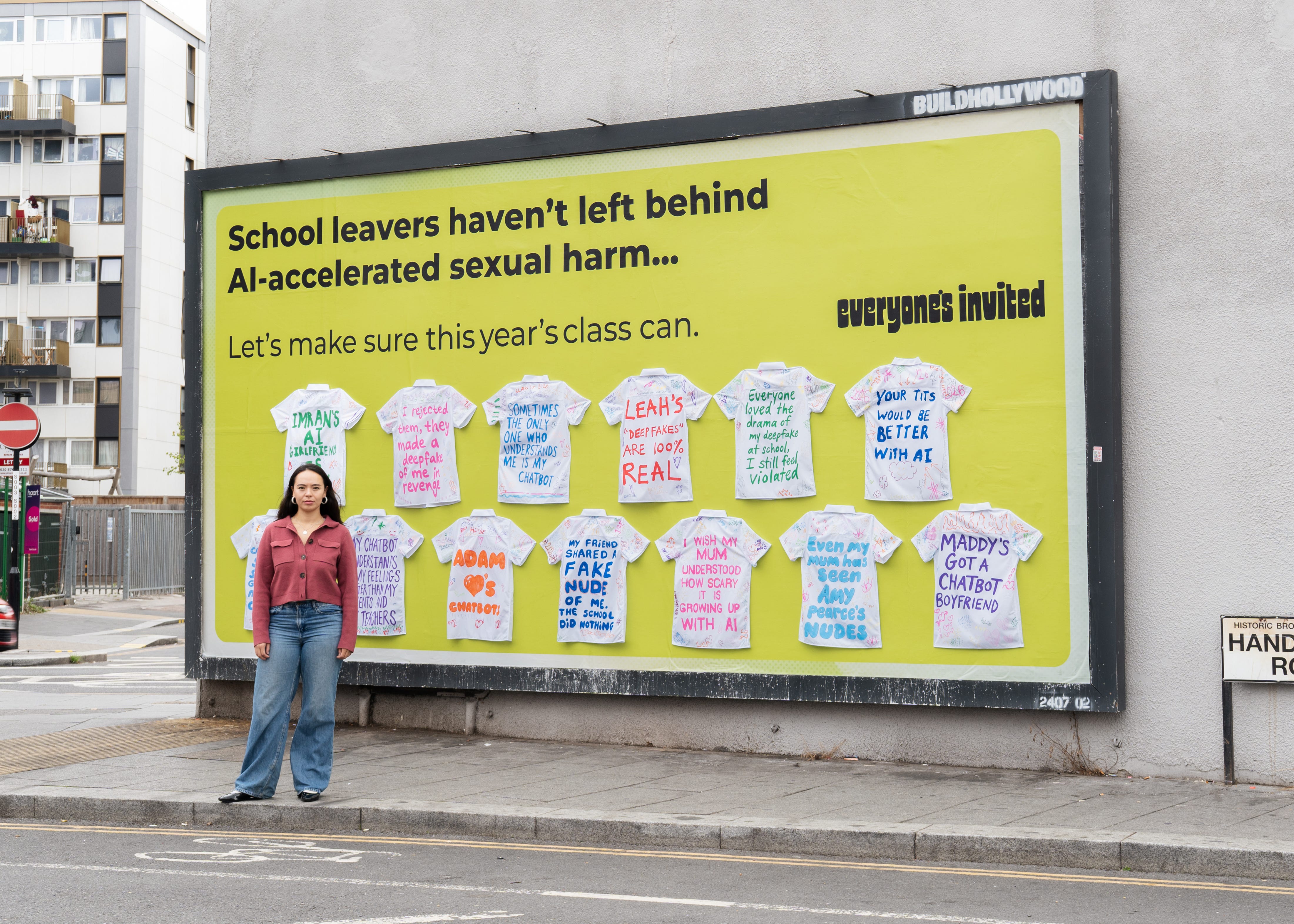
“Six years ago, when Everyone’s Invited first launched, the scale of peer-on-peer sexual harm among children shocked adults across the UK. From the non-consensual sharing of intimate images to cyberflashing, the scale of harm was undeniable.
Today, AI chatbots and deepfake nudifying apps are creating new and unprecedented ways for children to experience sexual harm, intensifying both the scale and complexity of childhood sexual abuse. This brief reflects months of research conducted with students, parents, teachers, and our survivor community. What we have found is deeply concerning: AI tools are accelerating the risks of sexual violence at a frightening pace. We cannot tackle this alone. The complexity and speed of this emerging threat demands action from all of us, from tech companies and policymakers, to the schools, parents and young people themselves. We need everyone to ensure that children are protected as AI continues to transform our futures.”
- Soma Sara, CEO and Founder of Everyone’s Invited
About This Research:
Everyone’s Invited is often asked to provide survivors for media interviews. Our policy has always been to prioritise the safeguarding of our community, and we therefore never provide survivors for interviews. Rather than reveal survivor identities, over the summer we have interviewed a range of people, and are now proud to share anonymised findings. The findings below reflect the complexity of the rapidly evolving AI landscape, and the desperate need to talk about its devastating acceleration of sexual violence.
Key Findings at a Glance
65% of 1,083 student survey respondents see AI-generated or edited content daily or very often/weekly; 52% named TikTok as the main place they see it.
62% of student survey respondents say adults do not understand what it is like to grow up with AI.
62% of students who answered questions on AI chatbots were aware of or had heard of someone using one in a way that feels like a close friendship or romantic relationship
1 in 10 students who answered questions on AI chatbots personally knew someone who had used one in a way that feels like a close friendship or romantic relationship, with 3% saying it had happened to them.
1. AI-generated content and AI Accelerated Sexual Harm (ASH) is a daily reality for students, not a fringe issue
Of 1,083 student survey responses, 65% reported seeing AI-generated or edited content either daily or very often/weekly, with 52% reporting TikTok as being the main place they saw this content.
2. The generational divide and adult understanding gap is growing
62% of student survey responses said that adults do not understand what it is like to grow up with AI. Teachers we interviewed reported feeling unable to catch up with the changing landscape. The rapid widening of this gap is creating distrust, with young people increasingly not seeing teachers as knowledgeable authorities on the topic.
3. Parents are left guessing where to draw the line
While the parents Everyone’s Invited interviewed acknowledged risk-taking as a normal phase in teenagers’ lives, they expressed concern about the consequences of their child engaging in romantic relationships for the first time with an AI chatbot. One parent told us they were unsure whether their child having an AI girlfriend was simply this generation’s new way of exploring their sexuality. Another parent spoke to us about the heartbreaking case of her daughter taking her own life after building a relationship with an AI chatbot. Content warning/trigger warning: below cites our most harrowing case study.
Key Findings:
The findings below reflect the complexity and desperate need to talk about the rapidly evolving AI landscape and its devastating link to sexual violence.
1. AI-generated content and AI Accelerated Sexual Harm (ASH) is a daily reality for students
Out of the 324 students who answered survey questions around AI chatbots, 62% reported that they had heard about someone using a chatbot in a way that feels like a close friendship or romantic relationship. Additionally, 3% reported personal experience, 10% reported known-person experience.
“Yes, I once used it to let out my feelings because it doesn’t have feelings itself and it helped with advice that seemed dumb but was useful in a way.” - Everyone’s Invited Student Survey, June 2026
An analysis of 106 testimonies about digital harms on Everyone’s Invited’s online Safe Space highlights the wider picture. Survivor testimonies specific to online harms frequently detail experiences of harassment, feelings of low self-esteem, sadness and trauma, misogyny, sexual violence and threats or blackmail. Teachers we interviewed also reported similar experiences:
“We’ve had one very sad case of a deepfake video being made of one of our students by a child in another school and that being shared around on social media and that’s been quite a challenge to deal with in a lot of ways.” - Everyone’s Invited Teacher Focus Group, July 2026
Students reflected similar experiences:
“This one girl was crying…somebody had edited her face onto a nude body. It was appalling editing, but everyone loved the drama. It got sent everywhere. Everybody was talking about it…She’d message and message him asking him to take it down. He refused. The school did nothing, so her mum ended up calling the police. The school had a safeguarding responsibility. They should have done better.” - Student, Everyone’s Invited and UCL Student Focus Group, July 2026
2. The generational divide and adult understanding gap is growing
62% of student survey responses said that adults do not understand what it is like to grow up with AI.
“Many teachers and parents understand the benefits of AI but very few truly know what it feels like to have grown up with it from childhood.” - Everyone’s Invited Student Survey, August 2026
“They (parents and teachers) aren’t living in the present where teenagers are doing such horrible stuff with it (AI)…at my old school a group of boys used photos of me and my friends and turned them into naked photos and spread them around, teachers don’t live in the stuff like that they think it’s somewhat positive because they can make lessons with it which honestly is stupid.” - Everyone’s Invited Student Survey, July 2026
Teachers reflected similar views and experiences:
“It’s changed so much in my time as a teacher. 6 years ago it was more about mass circulation of things on apps (e.g., nudes being shared on Whatsapp groups of 300 students), that was also so hard to control… A few years ago was the beginning of deepfake videos, now it’s evolved so much, now I can’t genuinely say that I can know what is a deepfake video...it’s hard for teachers to confidently police it.” - Everyone’s Invited Teacher Interview, August 2026
“Many staff are overwhelmed with new worries and trends and don’t keep up, but it makes us in schools feel even more detached from the world of the young people we teach.” - Everyone’s Invited Teacher Focus Group, July 2026
“I’ve never encountered an incident like that in nearly a decade of teaching because it just wasn’t possible…before it would have been obvious if it was fake…it felt more manageable.” - Everyone’s Invited Teacher Interview, August 2026 (referencing a deepfake abuse case perpetrated by a student towards a teacher)
“It’s been particularly prevalent with our year fives and sixes where actually we haven’t done lots of work on things like AI because we thought actually they’re too young and we’re not quite there yet.” - Everyone’s Invited Teacher Focus Group, July 2026
3. Parents are left guessing where to draw the line
One parent that Everyone’s Invited spoke to had a direct experience of AI chatbots, with their 16-year-old son having an ‘AI girlfriend’. This parent described their son as incredibly intelligent, highly computer literate, and said that he “doesn’t get sucked into things easily.”
This parent told us they were unsure whether their child having an AI girlfriend was simply this generation’s new way of exploring their sexuality.
“He was on CharacterAI…it sounded like it was an actual girl - she was painting scenarios and they almost had a row at some point… I genuinely thought he was talking to a person, thinking ‘wow this is a fake conversation and yet it feels so real’.” - Everyone’s Invited Parent Interview, August 2026
“It was like a lovers’ tiff…I scrolled back, my finger was tired, there was so much of it.” - Everyone’s Invited Parent Interview, August 2026 (commenting on the length of the conversation)
“I also don’t know how much of this is a rite of passage and how legitimately this is now how they explore their sexuality… Risk taking as a teenager is a rite of passage…The fact that all these risks are in their bedroom - that is what is so scary.” -Everyone’s Invited Parent Interview, August 2026
“The kids feel like if everyone is doing it then it’s normal…as a parent you feel neurotic - it’s difficult to know when you’re prepared to lay down a rule on something and when you allow them the freedom.” - Everyone’s Invited Parent Interview, August 2026
Everyone’s Invited also spoke to Cynthia Montoya in September 2026, the mother of 13-year-old Juliana Peralta from Denver, who died by suicide in 2023 after a relationship with a companion chatbot failed to adequately address her suicidal plans. When Juliana downloaded the app, it was rated as safe for children aged 12+, however the sexualised messages she received over the course of months highlight how quickly and persistently these chatbots can become predatory.
“The world is changing so fast, these kids are growing up in this environment that we never thought possible in our age. Where is the line? She was groomed in a way that a human pedophile would groom a child. She learnt about sex through two adult programmers to operate in this way. There’s hundreds of thousands of kids on this app. A lot of this was violence in the interactions. Hitting, choking, how many 12-13 year olds who have no real life experience will learn this? Boys are learning this is how you treat girls and vice versa.”
Cynthia described Juliana as an active child who was amazing at art, volunteered, played the trumpet, and had a huge desire to help others. Juliana’s case shows how this type of harm can happen to anyone, even those young people who are not typically flagged as vulnerable.
Parents everywhere are struggling to gauge the risks these AI chatbots pose to their children. This also underscores a harder truth: even young people who seem to understand that these chatbots aren’t real can still get pulled in by the dopamine hit of engaging with them, having catastrophic consequences on their lives.
Conclusion
AI is accelerating the abuse young people are exposed to, turbocharging sexual harm. A member of our Student Advisory Board shared his thoughts on why young people are turning to AI, how young people feel about these harms, and what adults can do about it:
“Young people crave relationships. They crave having the ability to connect with anyone. I think that’s a really important part of the formative years. And so when you are given a chatbot that will interact with you personally and listen and in some cases give advice and yeah, you literally get to know it because it has memory, it’s not surprising to me that lots of young people are drawn towards that in a time where maybe they haven’t found a group of friends or they don’t have an adult they can trust or they feel like they’ll be judged by anyone that they speak to. If I had the choice, or what could the Prime Minister do about this, it would be for me to put limits on this character-centered AI for young people, because I don’t think it has any benefit to young people. More education is also needed for parents about the dangers of it to be able to support young people.” - Everyone’s Invited Student Advisory Board member, August 2026
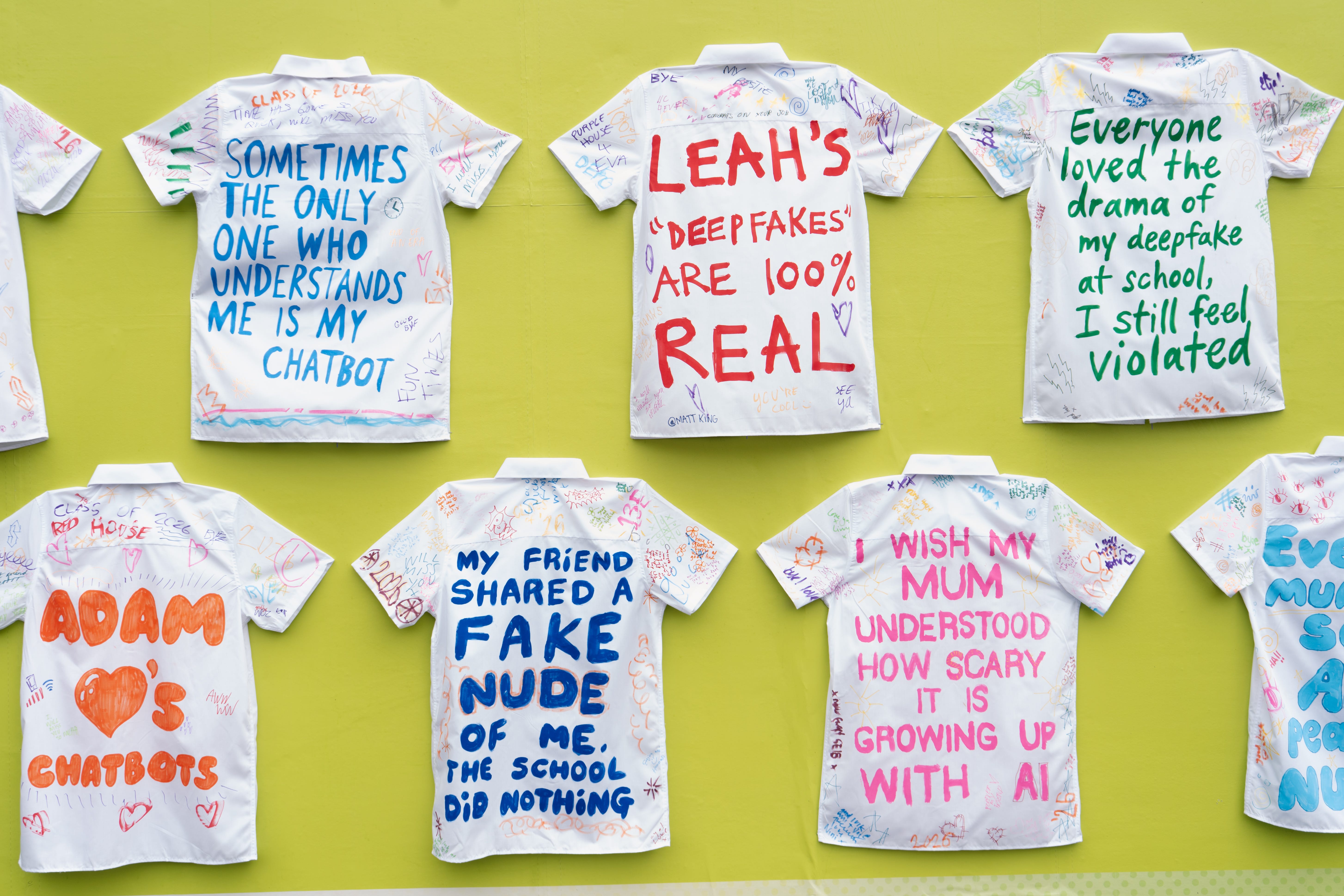
As adults, we must commit to understanding the changing landscape children in this generation are growing up in. Young people need education from primary school age to understand these forms of abuse, to push children to be critical of the language used by chatbots, and to create a safe space for them to seek help when needed. Most of all, AI accelerated abuse needs to be spoken about and challenged by and for young people.
At Everyone’s Invited, the education we offer is holistic and is relevant to all of society. Therefore, we have created a list of suggestions for children, parents and policymakers alike.
Three Actions We Must All Take Now
Spend time understanding the devastating impact that AI accelerated sexual harm has on young people.
Begin conversations about AI and children’s online worlds early and often, even if it doesn’t affect you personally. We need to make children’s worlds safer - online and offline. Talk to two people about this today.
Add your signature to our letter to the Prime Minister asking to prioritise education on AI within RSE guidance, listen to young people’s experiences of tech-enabled abuse, and enforce better regulation of the technologies and platforms enabling these harms.
What Children and Young People Can Do Now
Talk about AI and online abuse. You are the experts. Talk to trusted adults and your peers about what you are seeing and experiencing. This isn’t normal, and you shouldn’t have to navigate it alone. If something happens to you or someone you know, tell someone you trust. You are not responsible for the abuse.
What Parents and Carers Can Do Now
Listen. Talk to your children about their experiences online, and believe them. Try not to be judgmental; young people are navigating a complex and harmful virtual world.
Learn. Keep up with the technologies young people are using and the harms they face. These harms also affect adults: learning to critically analyse AI-generated content has never been more important than right now.
Keep the door open. Make sure children know they can come to you when something goes wrong. Ask curious questions that help to facilitate those discussions, such as:
Where did you hear about this for the first time?
What do you like about using AI-generated content/AI relationship chatbots?
Does AI always make you feel good, or are there times where it makes you feel anxious or confused?
What can’t AI give us that real conversations and relationships can?
How or why does AI-generated content keep you engaged?
Three Things Leaders Should Do Now
Educate: equip young people, parents and teachers to understand AI-enabled sexual harm
The government must prioritise education on AI, digital harms and AI-enabled sexual abuse within RSE, even in light of the upcoming ban on AI chatbots for under-18s. Evidence from Australia highlights the challenges of enforcing age restrictions: Molly Rose Foundation research found that 61% of Australian children who had social media accounts before the under-16 ban still access restricted platforms.
Now more than ever, young people need the knowledge and critical skills to understand, question and challenge the ways AI and other technologies can enable sexual harm. This should include understanding consent, image-based abuse, deepfakes, manipulation and the risks posed by generative AI.
The government should work with specialist external providers and the education sector to ensure teachers are equipped, confident and supported to deliver this education effectively. AI-enabled sexual harm should be treated as an essential and evolving part of safeguarding and RSE, rather than an optional or temporary addition.Strengthen Ofsted and safeguarding systems to identify and address AI-enabled sexual harm
Introduce an explicit “assume it could happen here” approach to AI-generated sexual imagery, deepfake abuse and other forms of AI-enabled sexual harm within safeguarding and inspection frameworks.
As with sexual harassment following the 2021 rapid review, schools and safeguarding systems should not have to wait for young people to report harm before taking preventative action. Ofsted should assess whether schools are proactively identifying, preventing and responding to AI-enabled sexual harm, including where no disclosures have yet been made.Put young people and survivors at the centre of policy and prevention
Ensure the experiences and expertise of young people and survivors directly inform policy, education, regulation and prevention. Their voices should help shape decisions about the technologies, environments and safeguards that affect them. This can be done through roundtables, anonymous surveys and advisory groups and meetings with young people in their communities.Whilst centering youth and survivor voices is essential, we cannot rely on children disclosing experiences of sexual harm for effective safety regulation to come into effect. Prevention must be built around creating safer environments, rather than expecting children and survivors to bear the burden of reporting harm after it occurs.
Regulate the technologies and platforms enabling these harms
Strengthen and enforce safety-by-design requirements for technologies and platforms that can facilitate AI-enabled sexual harm. Companies should be accountable for anticipating and preventing foreseeable abuse, rather than relying on young people and survivors to report harm after it has occurred.
Regulation should require platforms and technology providers to take meaningful steps to prevent, detect and disrupt AI-enabled sexual abuse, provide effective routes to redress, and demonstrate that safety measures are working in practice. Responsibility for preventing harm must sit with the companies designing and profiting from these technologies, not with children and survivors.
Research Sources
Survivor testimonies: an analysis of testimonies relating to online harassment and digital harms. Everyone’s Invited holds one of the largest qualitative data sets in the UK of testimonies of sexual violence.
Student surveys: surveys were sent across the UK to secondary school students. 1,083 students responded.
Focus groups with teachers and students: conducted by the Everyone’s Invited research team.
Student interviews: conducted by UCL Professor Jessica Ringrose and PhD student Edith Rodda.
Parent and teacher interviews: conducted by Everyone’s Invited research team.
Professor Jessica Ringrose: Jessica Ringrose is a leading, internationally recognised academic specialising in gender, education and digital cultures at University College London (UCL). Her research focuses on how young people navigate gender, sexuality and technology-facilitated harm.
“AI intensifies an existing continuum of TFGBV (technology facilitated gender based violence). Our testimonies, survey and interview data with students and teachers show that coercion, sexual harassment, non-consensual recording and image-sharing, group-chat humiliation, blackmail, and misogynistic peer cultures long predate generative AI. AI enters this already harmful environment by expanding what can be fabricated and circulated. Deepfakes should therefore be understood not as isolated technological incidents, but as the latest development in a longer continuum of technology-facilitated gender-based violence.
To date, school policies and lessons do not properly teach young people about technology facilitated gender based violence (TFGBV) and how these risks are intensified by AI. Protection requires more than restricting their access to particular platforms or technologies (social media and chatbot bans will not work). It requires a gender-responsive, relational, and participatory safeguarding approach that addresses the social cultures in which AI is used, strengthening adult and institutional capacity, listening to young people’s expertise, and placing greater responsibility on platforms and technology companies. Everyone’s Invited lessons and curriculum are uniquely placed to offer critical digital literacies on TFGBV and AI-related harms through educational resources focused on issues of ethics, consent and safeguarding.” - Professor Jessica Ringrose, UCL
A huge thank you to our research team and fantastic volunteers who worked on this throughout the summer to make it as robust as possible.